categorii
most popular
links
friends
studioBASAR

Search-And-Rescue (SAR): CITY
studioBASAR is an architecture office set up by Alex Axinte and Cristi Borcan in 2006 in the "search-and-rescue" formula, acting as an architectural observation and interventional agent through various surveys and constructions. 
SEARCH-AND-RESCUE (SAR): CITY becomes a strategic survey turned into an action programme investigating the dynamics of a modern city. SAR was initiated in 2006, as a collection of certain sections of analysis and diagnosis, run and tested in the urban space. The aim of those sections is to go publicly and refer to various marginal topics such as plainness, improvisation or unlawfulness as a part of the dynamic system of urban current culture. Locally, SAR aims to reinstate in the frame of an architect’s profession the need to explore the urban territory, public activism and social involvement.
MARGINAL
EVACUATING A GHOST
survival architecture
authors: studioBASAR (architects Alex Axinte and Cristi Borcan), legal adviser Sofia Mihăilescu

Based on the nationalization and retrocession of buildings in Romania, there is an extra house: a ghost home simply coming up on the streets, camping on pavements, clinging to the façades of the real homes and vanishing with no trail after a while. The ghost building has no walls, doors, windows or roof: it only has furniture, pillows, carpets, ficuses or cutlery, all displayed in successive loads and well packed in cardboard and protection sheets on which protest messages were written. The ghost house takes down in the street all those items collected by a family during their life inside; it is a house upside down.
Starting from a creative commitment and urban interest, we explore the extreme cases of forced evacuations from houses nationalized under the communist regime, currently retroceded to their former owners, as a case of urban survival underlining issues such as separation, social inequity, administrative incapacity and poverty. Looking at such precarious structures we learn about spatial and social organisation disregarding a normative functionality yet part of the ability to build your own living space.
A HABITAT IN BUCHAREST
authors: managed by studioBASAR (architects Alex Axinte and Cristi Borcan), together with landscape designers Vera Dobrescu (Faculty of Horticulture, Landscape Design section), and Diana Culescu (Faculty of Horticulture, Landscape Design section), researcher Dorel Ruşti (Grigore Antipa National Museum of Natural History) and architect Raluca Vişinescu (Bloc Office). Developed within the TUB project.

Who are Bucharest people now? And, what does this mean, to come from Bucharest, apart from living or going to work there? You are from Bucharest if you get your nest in a tree, dig your own burrow every spring, get your area to search for food every day or cling yourself to blind walls and fences. Bucharest inhabitants are also those crossing the zebra on four legs, taking the tram and living around the apartment buildings, getting their roots into parks and abandoned areas, going catching fish into Dâmboviţa river, and going back every evening in large flocks from the centre to the dormitories while others get together at night and keep flying in a circle around the bulbs. Other Bucharest inhabitants sharing the city with us are numerous and diverse.
The Habitat section attempts to explore the urban presence of some of the most common and representative species of plants and animals living in Bucharest. A map of the natural town and twenty cards about the “other inhabitants” referring to urban myths, collected data and useful advice; the local, the tourist and the expert are encouraged to explore the city as if a natural park.
ORDINARY
GRAZ THE USUAL CITY
Alex Axinte within the residentship Map XXL/Pepinieres Ostreich, 2006
The first investigation of this kind, ’Graz the Usual City’ (Alex Axinte, 2006) consisted in archiving some sincere and casual architectural units threatened by modernisation, embellishment or by the ‘bilbao effect’ from the Graz city, Austria. These units were still protecting the informal, which was more and more excluded from the hyper-controlled urban landscape of the Western Europe.
BUCHAREST NORMAL
authors: initiated by studioBASAR (architects Alex Axinte and Cristi Borcan), together with SYAA (architects Adrian Soare, Eliza Yokina and Magda Vieriu) – developed under the TUB project.
What is beautiful now in Bucharest, better than years ago or what will be beautiful sometime in the future? A whole world of dull places, haunted and forgotten, where normal, marginal and hidden events are rather avoided by the haste to develop the city and quietly waits to be wandered.
Going on with the means applied for Graz the Usual City, the Normal section selects, following an affectionate process of mapping, ten hidden places which are ignored, and places them on a trail. Seductive and mysterious, funny or occasional, the ten stops turn locals into tourists of their own city, while outside visitors get used to the unofficial city: left to wander the Utopia, Nostalgia, Dreams or Fears in a possible Bucharest.
BREZOIANU TRANSFER
authors: studioBASAR (architects Alex Axinte and Cristi Borcan) – developed under TUB project (www.t-u-b.ro).
The route of Brezoianu Street connects the North and the South between two urban nods, Splaiul Dâmboviţei (the banks of the river) and Sala Palatului (The multipurpose Palace Hall). Crossed in the middle by Elisabeta Boulevard, where it runs parallel with Cişmigiu Park, the street looks like a small scale alternative of Calea Victoriei. Based on “Monderman Model” as a reference (the Share Spaces concept developed by the Dutch traffic engineer Hans Monderman), Brezoianu turns into a generous space for passers-by, bike riders and various daily things, open to the occasional traffic and built as a dynamic transfer between Dâmboviţa and Sala Palatului. A set of material interventions and technical adjustments would not contradict the trends or separate the conflicts, but rather commit their upcoming energy. The strategy of “a city of small things” aims to regenerate the use of the most common urban utilities such as crossings, metal dwarfs, square fencings etc. as a direct and natural way to find a sequential character of a street. We leave open the informal and the social life, and encourage the spontaneous flow of life on the street.
IMPROVISED
The sparrows tree
Listen to what you see
The installation was part of the Ars Telefonica project, curators Alina Şerban, Anca Benera, Arnold Esteban, Cătălin Rulea, taking place between 23 and 27 September 2008 at the Visual Introspection Centre, Bucharest, RO (www.pplus4.ro)
Installation authors – studioBASAR (architects Alex Axinte and Cristi Borcan), panel graphic for the Sparrows Tree – Anca Benera and Arnold Esteban (pplus4), the story for the Sparrows Tree – Dorel Ruşti, Mariana Celac, Florin Mihăilescu

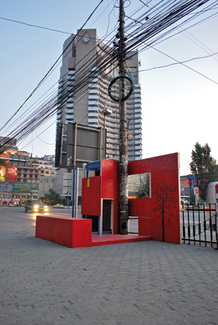
In an urban setting filled with wire and cables hanging from posts bent over welded fences, imprecisely stuck among broken tiles and cracked pavement, along coloured panels, iron sheets and trestles connected by pavement chains, tens of phone cabins sort of melt until getting transparent. Abandoned carcases, increasingly turned futile, outdated by the technological progress, an urban species on the stage of extinction, phone cabins are all bundled into a lumber of small things currently called the public space of Bucharest.
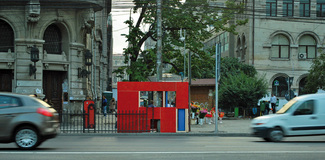
We have set in the University Square a structure similar to a red mantle covering an invisible phone cabin and turning it into a temporary stop: a platform for a place to stay, listen to and hear the city. Once entering the pavilion geometrically defined from the urban crowd, one could listen to the public phone, still functional, the history of a name: the Sparrows Tree, referring years ago to the area around the well at the university.
We state thus the recovering and documenting the minor memory equally part of a place full of monuments and major emotional landmarks, as well promoting a new attitude to the urban space design.
CĂRTUREŞTI, BENCH
Within the framework of Street Delivery event, taking place between 12th and 14th of June 2009, studioBASAR designed a bench. The liniar and dicreet intervention is placed in front of Carturesti bookstore, right on the conflictual boundary between an legally inaccessible green square and an abusive parking alley, and is using the existing elements: it sits right on the sidewalk curb and it’s tied to the metal fence. The bench takes a shelf like image from the library’s identity. The wooden structure is cladded in tego, left unpainted. Tego is an utilitarian material used as encasement for concrete, chosen here for it’s weather-proof structure and it’s strength against vandalism.
STAGING
THE SEDUCTIVENESS OF THE INTERVAL
Artists: Ştefan Constantinescu, Andrea Faciu and Ciprian Mureşan
Curator: Alina Şerban
Exhibition design: studioBASAR- Alex Axinte, Cristi Borcan
Collaborator: Livia Andreea Ivanovici
Structure Engineer - Cristi Botoi
Curator Assistant: Livia Pancu
Catalogue editors: Alina Şerban & Mirela Duculescu

The exhibition in the Romanian Pavilion can best be described as an attempt to put onto the stage a play in five acts, represented by the works of artists Ştefan Constantinescu, Andrea Faciu and Ciprian Mureşan. The three artistic positions are conceptually united within a site-specific installation conceived by the studioBASAR architectural group as a theatre set. By questioning the way in which the subjective vision of artists regulates the position of viewer and his relationship with the exhibition site, The Seductiveness of the Interval engages in a “theatrical” mode of dialogue with the viewer, inviting him to identify the network of causal links between multiple passages, sequences and transitions presented in the exhibition, in order ultimately to ensure the coherence of the whole.
Organizatori: Asociaţia Zeppelin, revista Arhitectura, KLUDIstudio
Sponsor: KLUDI
Susţinător al evenimentului: DULUX
Partener: Cărtureşti